Heavy-Duty Transport on Electricity: Germany's Truck Charging Network – Status 2025 and Forecast 2030
The heavy transport sector is undergoing a rapid transformation as electric semi trucks enter commercial service. Models such as the eActros 600 are now market-ready, but the charging infrastructure — especially high-power, megawatt-capable stations — remains the main bottleneck.
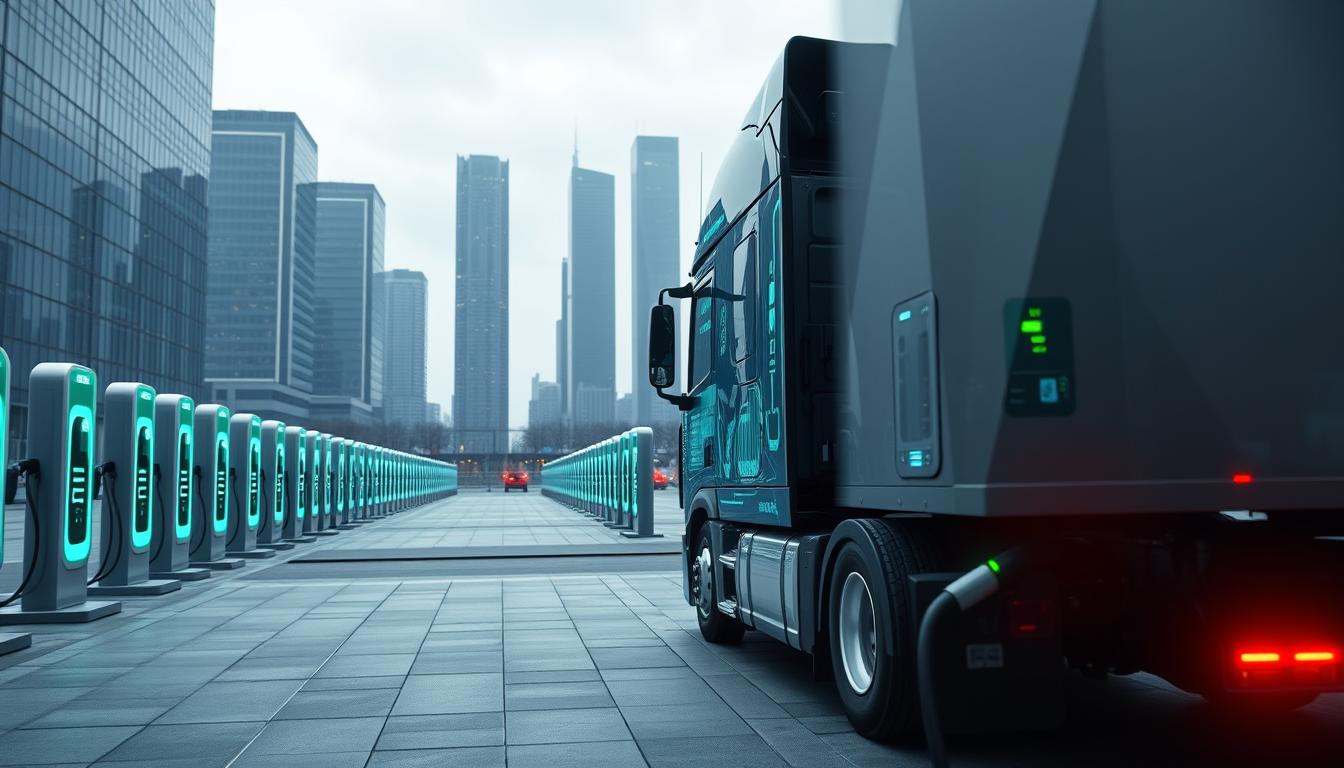
Germany is pushing to scale up its national network for electric truck charging, and developing robust Ladeinfrastruktur Schwertransport will determine how fast fleets can electrify. This article reviews the status at the end of 2025, lays out the technical and policy barriers, and forecasts what must happen by 2030 to meet EU and national targets.
Read on for a concise 2030 forecast and practical implications for fleet managers, infrastructure planners, and policymakers.
Key Takeaways
- Germany is expanding its electric truck charging infrastructure but gaps remain in truck-capable public points.
- Market-ready electric semi truck models like the eActros 600 demonstrate vehicle readiness for long-haul use.
- The charging network — space, grid capacity and megawatt charging availability — is the critical bottleneck.
- Forecasts show significant growth in electric semi truck adoption through 2030 if infrastructure deployment accelerates.
- Public and private projects, plus targeted millions in funding, are needed to scale MCS and depot solutions.
The Electric Revolution in Heavy Transport
The shift to electric heavy-duty vehicles is accelerating as fleets pursue lower operating costs and tighter emissions targets. Electric semi trucks (E-LKW) are moving from pilot fleets into commercial service, reshaping long-haul logistics and heavy-duty transport.
Market-Ready Electric Semi Trucks Like eActros 600
Production-ready electric semi truck models—most notably the eActros 600—are already on the road and demonstrating the viability of battery-electric power for medium and long-haul operations. These trucks promise lower fuel and maintenance costs compared with diesel equivalents and deliver clear emissions reductions. Early fleet trials report meaningful savings per kilometer and improved route noise profiles, supporting continued forschung and entwicklung into scale deployment.
The Critical Bottleneck: Charging Infrastructure
Vehicle readiness alone is not enough: widespread electrification depends on fast, reliable access to high-capacity charging. The lack of suitably located, high-power public chargers and depot upgrades remains the major barrier to rapid electrification of nutzfahrzeuge and heavy logistic fleets.
Key benefits and barriers (at a glance)
- Benefits: Lower operating cost per kilometer, reduced CO2 and local emissions, and quieter operation for urban and nighttime logistics.
- Barriers: Need for megawatt-class charging at strategic locations, substantial depot investments, and grid upgrades to support high simultaneous loads.
Ongoing projekt pilots and research into elektrifizierung show strong potential—but scaling requires co‑ordinated investment and policy support. Continue to the technical section to see how grid, megawatt charging standards, and AFIR regulations shape rollout plans.
Status Quo of Germany's Truck Charging Network (End of 2025)
The snapshot at the end of 2025 shows a growing fleet of electric semi trucks on German roads but a clear shortfall in public, truck-capable charging infrastructure. While the country has expanded overall public chargers, locations and power levels suitable for heavy-duty vehicles remain scarce.
The Infrastructure Discrepancy: 180,000 Public Charging Points
Germany reports roughly 180,000 public charging points in total, yet the vast majority are sized and sited for passenger EVs rather than heavy commercial vehicles. In practice, only a small fraction of those points are practically usable by semi trucks because they lack the parking space, throughput and electrical capacity required for depot- or on-route charging.
The core issue is that most public chargers cannot deliver the space or megawatt-class power delivery that heavy vehicles need. Industry observers note that existing passenger-focused infrastructure cannot be repurposed at scale without major upgrades to site layout and grid connections.
"The charging infrastructure for electric trucks is still in its infancy. We need specialized charging solutions that can handle the high power requirements of these vehicles." - Industry Expert
Passenger EV vs. Commercial Vehicle Charging Needs
Passenger EVs and heavy commercial vehicles have fundamentally different charging and site requirements. Semi trucks demand higher sustained power, larger turning and parking radii, and different payment and scheduling capabilities—factors that passenger chargers typically do not provide.
Space Requirements for Heavy Vehicles
Semi trucks require dedicated lanes and larger parking bays to maneuver and hook up to chargers safely. Practical site requirements include:
- Expanded parking footprint to accommodate trailers and turning circles
- Higher-capacity electrical equipment and protective civil works
- Specialized megawatt-capable hardware and cooling systems for sustained high-power charging
Power Delivery Limitations
Most publicly listed chargers were installed to serve passenger vehicles (50–150 kW). They are not designed to support the sustained, high-power demands of heavy vehicles.
| Vehicle TypeTypical Charging PowerCharging Time | ||
| Passenger EV | 50–150 kW | 30–60 minutes |
| Electric Truck / Semi Truck | 1–3 MW (megawatt-class) | 45 minutes (targeted fast charge with MCS; depends on battery size & state of charge) |
As Germany scales its ladeinfrastruktur for heavy transport, planners must distinguish between a "public charging point" (general-use passenger chargers) and "truck-compatible" or megawatt-capable sites that include appropriate space, power and operational procedures. Addressing these gaps—at rest areas, freight hubs and depots—will be essential to increase betrieb readiness for long-haul electric fleets.
Depot Charging: The Current Reality for Electric Semi Truck Operators
The practical reality for most electric semi truck operators today is that depot charging is the most feasible and immediately scalable solution given the limitations of public charging infrastructure. Until a dense network of truck‑capable, megawatt chargers exists along major routes, fleets will rely heavily on depot-based charging for daily operations and overnight top-ups.
Benefits and Limitations of Depot-Based Charging
Depot charging delivers several operational advantages: predictable availability, centralized energy management, and simplified scheduling. At the same time, it requires significant upfront investment and operational changes. As one industry practitioner put it, "Depot charging requires substantial capital and planning — but it yields reliable betrieb for electrified fleets."
Key benefits include:
- Reliable, scheduled charging that aligns with shift patterns and reduces range anxiety
- Lower per‑km energy and maintenance costs when combined with smart energy management
- Secure, controlled sites that simplify billing, access and asset management
Key limitations include high initial CAPEX, onsite grid upgrade needs, and potential operational disruptions during installation.
Cost Considerations for Fleet Operators
Fleet managers must evaluate both capital and operational cost drivers for depot charging. Typical cost categories include charger hardware, site civil works, on-site electrical upgrades (transformer, switchgear), and installation labor. Depending on site complexity, comprehensive depot upgrades can run from low‑hundreds of thousands to several million euros for large fleets — planning and financing structures are therefore critical.
Installation Expenses
Installation costs vary by scale and local grid conditions. Smart planning — right‑sizing charger count, implementing phased rollouts and leveraging public funding or utility programs — can lower upfront expenditures and speed the hochlauf of charging capacity.
Operational Adjustments
Operational changes are equally important: fleet operators need to redesign duty cycles, implement managed charging schedules to avoid peak demand charges, and integrate energy‑management systems that can route power where it’s needed. Smart charging and load‑management solutions let operators shift charging into off‑peak windows, reduce demand charges, and potentially allow surplus renewable energy to fließen direkt into vehicle batteries.
Simple decision checklist for fleet managers:
- Assess duty cycles: Can most charging happen overnight at depot?
- Model CAPEX vs. OPEX: Include grid-upgrade scenarios and financing options
- Plan smart charging: Implement an EMS to minimize peak demand charges
- Explore public funding and PPP models to de-risk the investment
By carefully planning installation and operational changes, electric semi truck operators can improve the wirtschaftlichkeit of electrified fleets and accelerate real‑world einsatz readiness.
Public Semi Truck Charging Points in Germany: Analysis of Current Infrastructure
The public charging infrastructure for heavy vehicles in Germany remains underdeveloped. As the country pursues electrification of long-haul logistics, the availability and distribution of public semi truck charging points in Germany (LKW Ladepunkte Deutschland) have become critical bottlenecks.
The Limited Network
By the end of 2025, Germany lists roughly 190–200 truck‑compatible charging points — a tiny slice of the roughly 180,000 public chargers reported for all vehicle types. Most truck‑compatible sites today are pilot locations testing technical setups, payment flows and operational concepts rather than full commercial rollouts.

Existing Pilot Projects and Their Performance
Pilot projects have been essential to understanding real‑world requirements for public truck charging. These trials (projekt) test technical configurations, user experience and uptime under realen bedingungen. Key pilot learnings include the need for robust payment and reservation systems, dedicated driver facilities at rest areas, and higher maintenance requirements for heavy‑use sites.
Regional Distribution
Truck‑capable chargers are unevenly distributed. Regions with major freight corridors and higher industrial activity host more pilot sites and higher utilization. Typical pockets of early deployment are concentrated along major autobahn routes and freight hubs.
Utilization Rates and User Experience
Utilization varies by location, charging speed and surrounding services. Common user experience issues include unreliable availability, limited ancillary services (restrooms, food) at some rastanlage, and varying payment interoperability across providers.
| RegionNumber of Truck ChargersUtilization Rate (%) | ||
| North Rhine-Westphalia | 50 | 60 |
| Bavaria | 40 | 55 |
| Baden-Württemberg | 30 | 50 |
Mini case: at a pilot rastanlage near the Autobahn, operators reported average session durations aligned to mandatory rest breaks but faced challenges with charger downtime and payment integration. Lessons like these shape larger rollouts under Deutschlandnetz and other public‑private projekts.
To meet demand, planners must scale standorten along major routes, especially highway rest areas (researched examples include rastanlage Lipperland and rastanlage Lipperland Süd), and provide consistent services every ~100–200 kilometer along freight corridors to match long‑haul operational patterns.
Ladeinfrastruktur Schwertransport: Technical Requirements and Challenges
Scaling reliable charging infrastructure for heavy transport is the technical backbone of large‑scale electrification. Heavy-duty electric vehicles and electric semi trucks place fundamentally different demands on site design, power delivery and control systems than passenger EVs—so planners must align grid upgrades, megawatt charging hardware and operational controls before large fleets can operate reliably.
Power Demands for Commercial Electric Vehicles
Commercial heavy vehicles require sustained, high-power charging to minimize downtime. Practical charging power ranges vary by use case: depot top-ups often use 350 kW+ chargers, while on-route rapid charging targets typically start at ~1 MW and can scale above 1.2 megawatt for fast replenishment; modern Megawatt Charging System (MCS) designs even allow for multi‑megawatt capability in future deployments. Exact charger sizing depends on vehicle battery capacity and duty cycle.
Grid Integration and Stability Concerns
Connecting megawatt‑class chargers to the existing distribution network can create localized stress on transformers, cables and protection systems. Without coordinated planning, high simultaneous loads risk supply instability or costly emergency upgrades. Grid reinforcement, managed charging strategies and coordination with distribution system operators (DSOs) are therefore essential.
Local Grid Reinforcement Needs
Typical reinforcement tasks include upgrading transformers, enlarging cable cross‑sections, adding switchgear and, in some cases, installing dedicated substations. Depending on permitting and construction complexity, a local reinforcement project can take months to more than a year and range from tens of thousands to multiple millions of euros per site for full megawatt‑class readiness.
Smart Charging Solutions
Smart charging and energy‑management systems are critical to limit peak power draw, shift load into off‑peak hours and integrate on‑site storage or renewables. Features include scheduled charging windows, dynamic load‑shedding, demand‑response participation and forecasting algorithms that match charging to available grid capacity. These systems improve wirtschaftlichkeit by reducing demand charges and enabling smoother hochlauf of charging capacity.
Research institutions such as the Fraunhofer‑Institut System‑ und Innovationsforschung (ISI) are studying realen bedingungen for grid integration and megawattladen strategies to inform deployment plans. Combining technical standards, piloted grid reinforcements and advanced charging control will be key to creating a resilient ladeinfrastruktur for heavy vehicles.
The Megawatt Charging System (MCS): Future Standard for E-Trucks
The Megawatt Charging System (MCS) is emerging as the technical backbone for fast, on-route charging of electric semi trucks. By enabling sustained, very high power transfer, MCS aims to make long‑haul electrification operationally feasible and to overcome current limits of depot-only strategies.
High‑Power Charging for a New Era
Technical Specifications and Charging Capabilities
MCS is designed to support sustained megawatt charging, with implementations and test systems demonstrating capabilities from around 1 MW up to multi‑megawatt levels in some prototypes. Vendor and standards work discuss theoretical peaks (for advanced setups) above 1.2 megawatt, with research variants exploring higher figures; reported upper bounds such as 3.75 MW reflect future proofing and experimental configurations rather than typical early commercial deployments. Actual achievable power depends on site grid capacity, thermal management and vehicle battery acceptance rates.
Full Charging During 45‑Minute Mandatory Rest Periods
MCS enables much faster energy replenishment than legacy chargers, potentially allowing significant battery top‑ups within the EU‑mandated 45‑minute rest windows for drivers. Whether a "full charge" is possible in 45 minutes depends on battery capacity, starting state of charge and the charge curve; in practical planning, MCS is best viewed as enabling large mid‑route replenishments that align with rest breaks rather than guaranteeing a full charge for every vehicle in every scenario.
Connector, Safety and Thermal Management
Megawatt charging requires specialized connectors, active cooling, and robust safety interlocks. Systems include liquid‑cooled cables, interlocks to prevent unsafe disconnection under load, and vehicle‑side cooling interfaces to manage battery temperature during high‑power sessions. Proper site design and maintenance regimes are essential to ensure reliability under heavy use.
Impact on Route Planning and Operations
Implementing MCS at strategic rest areas and freight corridors will change route planning: planners can build schedules that leverage 30–45 minute fast charges to maintain daily ranges without large battery oversizing. This improves utilization of nutzfahrzeuge and schwere lkw, reduces the need for excessive depot charging, and supports more efficient logistics.
What this means for drivers: predictable rest‑stop charging windows, potential reservation or queuing systems, and variable pricing models where high‑power sessions may cost more but reduce total downtime.
"The Megawatt Charging System represents a major milestone in our journey towards sustainable transportation. With its high‑power charging capabilities, we can now support broader adoption of electric semi trucks, lowering emissions and improving air quality."
EU Regulations Driving Infrastructure Development
AFIR (the Alternative Fuels Infrastructure Regulation) sets binding EU requirements to accelerate and standardize charging infrastructure across member states — and it directly shapes the rollout of semi truck charging along major freight corridors. For international logistics and long‑haul operators, AFIR creates a regulatory backbone that makes investment planning and cross‑border operations more predictable.
AFIR Requirements: 314 Mandatory Truck Charging Locations by 2030
Under AFIR, Germany is required to deliver at least 314 truck charging locations by 2030. These locations must be strategically placed to support national and international freight movement and to ensure continuity along the autobahn network.
Implementation Timeline and Compliance Strategies
Meeting AFIR requires a clear implementation plan built on the following elements:
- Mapping and prioritizing suitable standorten (rest areas, freight hubs and depots) along core corridors
- Investing in high‑power megawatt charging systems and local grid reinforcements
- Coordinating with DSOs and federal authorities to secure permits and energy supply
Successful compliance hinges on joint public‑private projekt models, transparent analysen of demand and pragmatic funding packages — including targeted millions of euros in public support to de‑risk early sites and catalyze private investment.
Penalties for Non-Compliance
Non‑compliance can have consequences beyond reputational damage: it may affect access to certain EU funds and lead to follow‑up measures from the Commission. The exact mechanisms depend on monitoring outcomes and the national implementation plan’s transparency.
Monitoring and Reporting Mechanisms
The EU requires regular progress reports and data sharing so AFIR targets can be tracked. On this basis, Germany must demonstrate that deployment aligns with the regulation’s ziel and underlying grundlage of ensuring interoperable, reliable charging access across the bundes network. Stakeholders such as the staatssekretär and ministers (communications frequently include quotes from officials like Christian Hirte) will rely on these analyses to steer further policy and funding decisions.
Where feasible, planning should enable renewable energy or local storage to fließen direkt into charging sessions, reducing grid stress and improving the environmental case for electrification.
Germany's National Plan: The "Deutschlandnetz" Initiative
The German federal plan known as "Deutschlandnetz" sets out a national strategy to deliver a reliable charging backbone for electric semi trucks along major corridors. By concentrating efforts on high‑priority rest areas and freight hubs, the initiative aims to make long‑distance electric freight feasible and predictable for operators.
Strategic Coverage: 350 Highway Rest Areas for Truck Charging
The Deutschlandnetz target is to equip roughly 350 highway rest areas (rastanlage) with truck‑capable charging infrastructure. These standorten are chosen to optimize network coverage for long‑haul fernverkehr, ensuring drivers can access fast charging at regular intervals and supporting cross‑border transport flows.
Location selection for the 350 sites is based on traffic analyses, freight density and route optimization to maximize utility for fleet operators while minimizing unnecessary overlap.
Public‑Private Partnership Models
Realising Deutschlandnetz depends heavily on public‑private cooperation. Public partners typically provide land access, permitting support and seed funding, while private operators bring construction expertise, commercial operation capabilities and maintenance services. These partnership models are structured to balance risk and reward and accelerate deployment.
Funding Allocation
Funding combines federal grants, regional contributions and private capital. Early phases will require targeted public investment — often in the form of millions of euros — to catalyze private participation and de‑risk initial sites. Clear funding windows and transparent allocation are essential to speed the hochlauf of the charging network.
Construction and Operational Responsibilities
Responsibilities are typically split: public bodies handle site identification and regulatory compliance, while private partners manage construction, commissioning and day‑to‑day operations. This division helps leverage commercial expertise for maintenance and service quality while ensuring public interests (accessibility, interoperability and safety) are protected.
Expert Forecasts: The Need for 1,000–2,000+ Public MCS Points by 2030
Independent analyses and industry forecasts indicate that to fully support projected electric semi truck fleets, Germany will likely need between 1,000 and 2,000+ public Megawatt Charging System (MCS) points by 2030 — well beyond the initial 350 rest‑area rollouts. Closing that gap requires scaling beyond Deutschlandnetz’s first wave, broadening site types and mobilizing further private investment.
The development of MCS points is essential for long‑haul operations and directly impacts fleet wirtschaftlichkeit. Strategic planning must include space for queuing, driver facilities and ancillary services so each site can serve as a practical stop on long routes.

Quick rollout checklist for planners:
- Prioritize standorten by freight volume and distance between existing charger sites (target ~100–200 kilometer spacing on main corridors).
- Secure early eröffnung pilots to validate technical and commercial models (projekt hola or similar pilots).
- Allocate seed funding (millions of euros) to remove key barriers and attract operators.
- Integrate research findings (forschung) into deployment standards to optimize uptime and user experience.
Addressing site selection, funding and operational models early will create the necessary raum — physical and commercial — for widespread MCS adoption and ensure Germany’s network supports realistic long‑haul operations.
Conclusion: Bridging the Gap Between Current Reality and 2030 Vision
Closing the gap between today’s limited network and the 2030 vision for electric semi truck charging in Germany will require coordinated action from policymakers, infrastructure operators and fleet owners. The technical readiness of vehicles is no longer the main barrier — the decisive factor is scaling reliable, megawatt‑capable ladeinfrastruktur and the commercial models that make it economical to operate heavy electric vehicles.
Today’s public figures illustrate the challenge: while Germany reports roughly 180,000 public charging points overall, only about 190–200 are truck‑compatible as of 2025. To meet AFIR obligations (314 mandatory truck charging locations by 2030) and serve projected fleet growth, Germany needs to expand beyond initial programs and the Deutschlandnetz first wave — ultimately aiming for an estimated 1,000–2,000+ public MCS sites to support long‑haul operations.
Key areas to prioritize are targeted public funding (tens of millions to seed early sites), accelerated forschung and pilots under realen bedingungen (to validate megawattladen and operational concepts), and faster roll‑out of high‑capacity sites at strategic rastanlage such as rastanlage Lipperland and rastanlage Lipperland Süd along major autobahn corridors.
Action checklist
- For policymakers: Lock in funding windows, streamline permitting, and coordinate with DSOs so grid reinforcements don’t bottleneck eröffnung.
- For infrastructure operators / private partners: Pilot scalable MCS deployments, refine commercial models and plan for queuing, driver facilities and maintenance to improve uptime.
- For fleet managers: Prioritize depot investment, plan mixed depot/on‑route charging strategies, and run ROI analyses to leverage available public support.
By combining practical analysen, smart public‑private projekt structures and funding that lets private capital flow, Germany can deliver the physical and commercial raum for wide adoption of electric semi trucks and ensure the long‑distance fernverkehr remains efficient and competitive.
FAQ
What is the current status of Germany's truck charging network as of 2025?
As of 2025 Germany reports ~180,000 public chargers overall, but only about 190–200 are truck‑compatible. The majority serve passenger EVs; truck sites require more space and higher power.
Why are more MCS public points needed?
Megawatt Charging System (MCS) points enable fast on‑route replenishment that aligns with driver rest periods and long‑haul duty cycles. Analysts estimate 1,000–2,000+ public MCS points are needed by 2030 to support projected fleet growth and operational patterns.
What role do pilot projects play?
Pilots test technical setups, payment flows and uptime under realen bedingungen. Results inform standards for megawattladen, guide forschung priorities, and improve the wirtschaftlichkeit of larger rollouts.
Next steps: download our 2030 infrastructure checklist or contact us for a fleet readiness audit to map your depot and route charging strategy.